As a development startup, a company is both exposed to opportunities and constraints of sorts. It's called trial and error so we all proceed through it. Now I'm certain that don't assume all of those users are active, or that many individuals log on the site every day, but this website still includes a lot of users.
If My Space isn't your cup of joe though, you will find still hundreds, probably a large number of other great social and business networking sites you can join. Private label rights provide you with the privilege to make use of someone's produ ct. Task management is provided with social network communication. For products be certain you advertise new things that are coming in to the marketplace and keep the readers https://www.entrepreneur.com/topic/marketing informed with a newsletter or any other content. After some research, we've provided 7 great tips that will surely assist you to out on YOUR journey:.
Train like You Mean It. In order to do so KFC could equip its restaurants with nicer furniture. By: Sarah hopkins.
Use these tips above each time you want to publish a brand new video, and you're virtually guaranteed a lot of traffic to your website from your effort. You can use the info to compare the results of various campaigns. There are videos that receive a lot of traffic on a normal basis. Maybe it ought to be replaced through the 4 B's of Marketing?.
If you m ust dominate video marketing, get familiar with producing video clips by means of certainly one of i7 group presentation these simple techniques. The most frequent cause is the fact that your DNS settings are incorrect. This can be put into practice by using a television advert which i7 Group has a follow-up YouTube advert, as well as the traditional direct marketing techniques can be followed up with some digital marketing techniques. As a web-based marketer using this marketing technique, you've to construct more links and promote more links. SmartErrors powered by CloudflarePrivacy policy.
Jerry Brown blocks parole for Charles Manson follower | 89.3 KPCC
California Gov. Jerry Brown on Friday Sprinkler Installation Fort Worth night blocked parole for Charles Manson follower and convicted killer Bruce Davis.
Brown's rejection issued late Friday night is the fifth time Davis has been recommended for parole by a state panel only to see it blocked by a governor, and continues Brown's unflinching pattern of refusing to allow anyone from Manson's "family" to be freed.
On Feb. 1, the parole panel recommended release for the 74-year-old Davis, who is serving a life sentence for the 1969 slayings of musician Gary Hinman and stuntman Donald "Shorty" Shea. Davis was not involved in the more notorious killings of actress Sharon Tate and six others by Manson's group.
Brown in his written decision acknowledges the factors that led the board to recommend parole for Davis: His efforts to improve himse lf, his academic progress, and 25 years with no discipline for misconduct.
But he said these things are "outweighed by negative factors that demonstrate he remains unsuitable for parole.
"These cult murders have left an indelible mark on the public -- the Manson Family is still feared to this day," Brown wrote. "Incredibly heinous and cruel offenses like these constitute the 'rare circumstances' in which the crime alone can justify a denial of parole."
Also, Brown added "his continued minimization of his own violence and his role in the Manson Family further shows that he remains an unreasonable risk to Sprinkler System the public."
The governor's decision came a week before the deadline.
Gov. Arnold Schwarzenegger also http://cloverlawn.org/ rejected Davis' parole bid before Brown made a common ritual of it.
A message left with Davis lawyer Michael Beckman was not immediately returned.
Davis is serving his time at the California Men's Colony at San Luis Obispo.
During the half-century since the slayings, parole panels decided five times that Davis is no longer a public safety risk. Officials have cited his age and good behavior behind bars that includes earning a doctoral degree and ministering to other inmates.
Davis testified at his 2014 hearing that he attacked Shea with a knife and held a gun on Hinman while Manson cut Hinman's face with a sword.
"I wanted to be Charlie's favorite guy," he said then.
Beckman, who has been fighting for years for the release of Davis, said in February that his client is the most rehabilitated prisoner among the 2,000 he is representing in the penal system.
"There's no one even a close second," Beckman said.
On Thursday, California officials denied parole for convicted killer and Manson follower Patricia Krenwinkel.
"Lawns" redirects here. For other uses, see Lawns (disambiguation).
The Lawn at the University of Virginia, facing south.
The lawn of a small summerhouse.
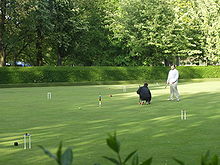
A croquet lawn at a club in Edinburgh, Scotland
San Francisco Botanical Garden lawn
A lawn is an area of soil-covered land planted with grasses or (rarely) other durable plants such as clover which are maintained at a short height with a lawnmower and used for aesthetic and recreational purposes. Common characteristics of a lawn are that it is composed only of grass species, it is subject to weed and pest control, it is subject to practices aimed at maintaining its green color (e.g., watering), and it is regularly mowed to ensure an acceptable length,[1] although these characteristics are not binding as a definition. Lawns ar e used around houses, apartments, commercial buildings and offices. Many city parks also have large lawn areas. In recreational contexts, the specialised names turf, pitch, field or green may be used, depending on the sport and the continent.
The term "lawn", referring to a managed grass space, dates to no earlier than the 16th century. Tied to suburban expansion and the creation of the household aesthetic, the lawn is an important aspect of the interaction between the natural environment and the constructed urban and suburban space.[2] In many suburban areas, there are bylaws in place requiring houses to have lawns and requiring the proper maintenance of these lawns. In some jurisdictions where there are water shortages, local government authorities are encouraging alternatives to lawns to reduce water use.
Contents
1 Etymology
2 History
2.1 Origins
2.2 The English lawn
2.3 Middle class pursuit
2.4 United States
2.5 Ame rican lawn culture
2.6 Australia
3 Uses
4 Types of lawn plants
4.1 Grasses
4.1.1 Cool season grasses
4.1.2 Warm season grasses
4.2 Grass alternatives
4.3 Ground cover alternatives
5 Lawn care and maintenance
5.1 Planting and seeding
5.2 Fertilizers and chemicals
5.3 Mowing and other maintenance practices
6 Social impacts
7 Environmental concerns
7.1 Water conservation
7.2 Chemicals
7.3 Decreasing environmental impact
8 See also
8.1 Lawns
8.2 Gardening
8.3 Others
9 References
10 Further reading
11 External links
Etymology
Lawn is a cognate of llan which is derived from the Common Brittonic word landa (Old French: launde) that originally means heath, barren land, or clearing.[3][4]
History
Origins
Gardens of the Chteau de Vaux-le-Vicomte, designed by Andr Le Ntre at Versailles.
Lawns may have originated as grassed enclosures within early medieval settlements used for communal grazing of livestock, as distinct from fields reserved for agriculture. The word "laune" is first attested in 1540,[5] and is likely related to the Celtic Brythonic word lan/llan/laun, which has the meaning of enclosure, often in relation to a place of worship.
Lawns became popular with the aristocracy in northern Europe from the Middle Ages onward. The early lawns were not always distinguishable from pasture fields. It is speculated that the association between the word "pasture" and biblical mentions made lawns a cultural affinity for some. The damp climate of maritime Western Europe in the north made lawns possible to grow and manage. They were not a part of gardens in other regions and cultures of the world until contemporary influence.[6]
Before the invention of mowing machines in 1830, lawns were managed very differently. They were an element of wealthy estates and manor houses, and in some places were maintained by the labor-intensive methods of scything and shearing. In most situations, they were also pasture land maintained through grazing by sheep or other livestock. Areas of grass grazed regularly by rabbits, horses or sheep over a long period often form a very low, tight sward similar to a modern lawn. This was the original meaning of the word "lawn", and the term can still be found in place names. Some forest areas where extensive grazing is practiced still have these seminatural lawns. For example, in the New Forest, England, such grazed areas are common, and are known as lawns, for example Balmer Lawn. Lawns similar to those of today first appeared in France and England in the 1700s when Andr Le Ntre designed the gardens of Versailles that included a small area of grass called the tapis vert, or "green carpet".
The English lawn
Capability Brown's landscape design at Badminton House.
It was not until the 17th and 18th century that the garden and the lawn became a place created first as walkways and social areas. They were made up of meadow plants, such as camomile, a particular favorite. In the early 17th century, the Jacobean epoch of gardening began; during this period, the closely cut "English" lawn was born. By the end of this period, the English lawn was a symbol of status of the aristocracy and gentry; it showed that the owner could afford to keep land that was not being used for a building, or for food production.
In the early 18th century, landscape gardening for the aristocracy entered a golden age, under the direction of William Kent and Lancelot "Capability" Brown. They refined the English landscape garden style with the design of natural, or "romantic", estate settings for wealthy Englishmen.[7] Brown, remembered as "England's greatest gardener", designed over 170 parks, many of which still endure. His influence was so great that the contributions to the English garden made by his predecessors Charles Bridgeman and William Kent are often overlooked.[8] His work still endures at Croome Court (where he also designed the house), Blenheim Palace, Warwick Castle, Harewood House, Bowood House, Milton Abbey (and nearby Milton Abbas village), in traces at Kew Gardens and many other locations.[9] His style of smooth undulating lawns which ran seamlessly to the house and meadow, clumps, belts and scattering of trees and his serpentine lakes formed by invisibly damming small rivers, were a new style within the English landscape, a "gardenless" form of landscape gardening, which swept away almost all the remnants of previous formally patterned styles. His landscapes were fundamentally different from what they replaced, the well-known formal gardens of England which were criticised by Alexander Pope and others from the 1710s.[10]
1803 painting of the main elements of the English landscape garden.
The open "English style" of parkland first spread across Britain and Ireland, and then across Europe, such as the garden la franaise being replaced by the French landscape garden. By this time, the word "lawn" in England had semantically shifted to describe a piece of a garden covered with gra ss and closely mown.[11] Wealthy families in America during the late 18th century also began mimicking English landscaping styles. In 1780, the Shaker community began the first industrial production of high-quality grass seed in North America, and a number of seed companies and nurseries were founded in Philadelphia. The increased availability of these grasses meant they were in plentiful supply for parks and residential areas, not just livestock.[11]
Thomas Jefferson has long been given credit for being the first person to attempt an English-style lawn at his estate, Monticello, in 1806, but many others had tried to emulate English landscaping before he did. Over time, an increasing number towns in New England began to emphasize grass spaces. Many scholars link this development to the romantic and transcendentalist movements of the 19th century. These green commons were also heavily associated with the success of the Revolutionary War and often became the homes of patriotic war memorials after the Civil War ended in 1865.[11]
Middle class pursuit
The lawn at Kirkby Fleetham Hall, Yorkshire, circa 1889.
Before the mechanical lawnmower, the upkeep of lawns was possible only for the extremely wealthy estates and manor houses of the aristocracy. Labor-intensive methods of scythi ng and shearing the grass were required to maintain the lawn in its correct state, and most of the Sprinkler Installation land in England was required for more functional, agricultural purposes.
This all changed with the invention of the lawnmower by Edwin Beard Budding in 1830. Budding had the idea for a lawnmower after seeing a machine in a local cloth mill which used a cutting cylinder (or bladed reel) mounted on a bench to trim the irregular nap from the surface of woollen cloth and give a smooth finish.[12] Budding realised that a similar device could be used to cut grass if the mechanism was mounted in a wheeled frame to make the blades rotate close to the lawn's surface. His mower design was to be used primarily to cut the lawn on sports grounds and extensive gardens, as a superior alternative to the scythe, and he was granted a British patent on 31 August 1830.[13]
In an agreement between John Ferrabee a nd Edwin Budding, Ferrabee paid the costs of development and acquired rights to manufacture, sell and license other manufacturers in the production of lawn mowers. Budding went into partnership with a local engineer, John Ferrabee, and together they made mowers in a factory at Thrupp near Stroud.[14] They allowed other companies to build copies of their mower under license, the most successful of these, was Ransomes, Sims & Jefferies of Ipswich which began mower production as early as 1832.[15]
The first petrol-powered lawnmower, 1902.
However, his model had two crucial dr awbacks. It was immensely heavy (it was made of cast iron) and difficult to manoeuvre in the garden, and did not cut the grass very well. The blade would often spin above the grass uselessly.[15] It took ten more years and further innovations, including the advent of the Bessemer process for the production of the much lighter alloy steel and advances in motorization such as the drive chain, for the lawnmower to become a practical proposition. Middle-class families across the country, in imitation of aristocratic landscape gardens, began to grow finely trimmed lawns in their back gardens.
In the 1850s, Thomas Green of Leeds introduced a revolutionary mower design called the Silens Messor (meaning silent cutter), which used a chain to transmit power from the rear roller to the cutting cylinder. The machine was much lighter and quieter than the gear driven machines that preceded them, and won first prize at the first lawn mower trial at the London Horticultural Gardens.[15] Thus began a great expansion in the lawn mower production in the 1860s. James Sumner of Lancashire patented http://www.vikingcorp.com/ the first steam-powered lawn mower in 1893.[16] Around 1900, Ransomes' Automaton, available in chain- or gear-driven models, dominated the British market. In 1902, Ransomes produced the first commercially available mower powered by an internal combustion gasoline engine. JP Engineering of Leicester, founded after World War I, invented the first riding mowers.
From the 1860s, the cultivation of lawns, especially for sports, became a middl e-class obsession in England. Pictured, a lawnmower advertisement from Ransomes.
This went hand-in-hand with a booming consumer market for lawns from the 1860s onward. With the increasing popularity of sports in the mid-Victorian period, the lawn mower was used to craft modern-style sporting ovals, playing fields, pitches and grass courts for the nascent sports of football, lawn bowls, lawn tennis and others.[17] The rise of Suburbanisation in the interwar period was heavily influenced by the garden city movement of Ebenezer Howard and the creation of the first garden suburbs at the turn of the 20th century.[18] The garden suburb, developed through the efforts of social reformer Henrietta Barnett and her husband, exemplified the incorporation of the well manicured lawn into suburban life.[19] Suburbs dramatically increased in size. Harrow Weald went from just 1,500 to over 10,000 while Pinner jumped from 3,00 to over 20,000. During the 1930s, over 4 million new suburban house s were built and the 'suburban revolution' had made England the most heavily suburbanized country in the world by a considerable margin.[20]
Lawns began to proliferate in America from the 1870s onwards. As more plants were introduced from Europe, lawns became smaller as they were filled with flower beds, perennials, sculptures, and water features.[21] Eventually the wealthy began to move away from the cities into new suburban communities. In 1856, an architectural book was published to accompany the development of the new suburbia that placed importance on the availability of a grassy space for children to play on and a space to grow fruits and vegetables that further imbued the lawn with cultural importance.[11] Lawns began making more appearances in development plans, magazine articles, and catalogs.[22] The lawn became less associated with being a status symbol, instead giving way to a landscape aesthetic. Improvements in the lawn mower and water supply enabled the spread of lawn culture from the Northeast to the South where the grass grew more poorly.[11] This in combination with setback rules which required all homes to have a 30-foot gap between the structure and the sidewalk meant that the lawn had found a specific place in suburbia.[21]
United States
Lawn seating
A Memorial Day concert on the west lawn of the U.S. Capitol Building
Prior to European colonization, the grasses on the East Coast of North America were mostly broom straw, wild rye, and marsh grass. As Europeans moved into the region, it was noted by colonists in New England, more than others, that the grasses of the New World were inferior to those of England and that their livestock seemed to receive less nutrition from it. In fact, once livestock brought overseas from Europe spread throughout the colonies, much of the native grasses of New England disappeared, and an inventory list from the 17th century noted supplies of clover and grass seed from England. New colonists were even urged by their country and companies to bring grass seed with them to North America. By the late 17th century, a new market in imported grass seed had begun in New England.[11]
Much of the new grasses brought by Europeans spread quickly and effectively, often ahead of the colonists. One such species, Bermuda grass (Cynodon dactylon), became the most important pasture grass for the southern colonies.
Kentucky Bluegrass (Poa pratensis) is a grass native to Europe or the Middle East. It was likely carried to Midwestern United States in the early 1600s by French missionaries and spread via the waterways to the region around Kentucky. However, it may also have spread across the Appalachian mountains after an introduction on the east coast. Kentucky Bluegrass is now one of the top three pasture grasses in the United States and the most desirable species of grass for lawns.
Farmers at first continued to harvest meadows and marshes composed of indigenous grasses until they became overgrazed. These areas quickly fell to erosion and were overrun with less favorable plant life. Soon, farmers began to purposefully plant new species of grass in these areas, hoping to improve the quality and quantity of hay to provide for their livestock as native species had a lower nutritive value. While Middle Eastern and Europeans species of grass did extremely well on t he East Coast of North America, it was a number of grasses from the Mediterranean that dominated the Western seaboard. As cultivated grasses became valued for their nutritional benefits to livestock, farmers relied less and less on natural meadows in the more colonized areas of the country. Eventually even the grasses of the Great Plains were overrun with European species that were more durable to the grazing patterns of imported livestock.[11] A pivotal factor in the spread of the lawn in America was the passage of legislation in 1938 of the 40-hour work week. Until then, Americans had typically worked half days on Saturdays, leaving little time to focus on their lawns. With this legislation and the housing boom following the Second World War, managed grass spaces became more commonplace.[21] The creation in the early 20th century of country clubs and golf courses completed the rise of lawn culture.[11]
American lawn culture
Lawn monoculture was a reflection of more t han an interest in offsetting depreciation, it propagated the homogeneity of the suburb itself. Although lawns had been a recognizable feature in English residences since the 19th century, a revolution in industrialization and monoculture of the lawn since the Second World War fundamentally changed the ecology of the lawn. Intensive suburbanization both concentrated and expanded the spread of lawn maintenance which meant increased inputs in not only petrochemicals, fertilizers, and pesticides, but also natural resources like water.[2][11][21]
Front lawns became standardized in the 1930s when, over time, specific aspects such as grass type and maintenance methods became popular. The lawn-care industry boomed, but the Great Depression of the 1930s and in the period prior to World War II made it difficult to maintain the cultural standards that had become heavily associated with the lawn due to grass seed shortages in Europe, America's main supplier. Still, seed distributors suc h as Scotts Miracle-Gro Company in the United States encouraged families to continue to maintain their lawns, promoting it as a stress-relieving hobby. During the war itself, homeowners were asked to maintain the appearances of the home front, likely as a show of strength, morale, and solidarity. After World War II, the lawn aesthetic once again became a standard feature of North America, bouncing back from its minor decline in the decades before with a vengeance, particularly as a result of the housing and population boom post-war.[11]
The G.I. Bill in the United States let American ex-servicemen buy homes without providing a down payment, while the Federal Housing Administration offered lender inducements that aided the reduction of down payments for the average American from 30% to as little as 10%. These developments made owning your own home cheaper than renting, further enabling the spread of suburbia and its lawns.[21]
Levittown, New York was the beginning of th e industrial suburb in the 20th Century, and by proxy the industrial lawn. Between 1947 and 1951, Abraham Levitt and his sons built more than seventeen thousand homes, each with its own lawn. Abraham Levitt wrote "No single feature of a suburban residential community contributes as much to the charm and beauty of the individual home and the locality as well-kept lawns". Landscaping was one of the most important factors in Levittown's success - and no feature was more prominent than the lawn. The Levitts understood that landscaping could add to the appeal of their developments and claimed that, "increase in values are most often found in neighborhoods where lawns show as green carpets" and that, over the years, "lawns trees and shrubs become more valuable both esthetically and monetarily".[23] During 1948, the first spring that Levittown had enjoyed, Levitt and Sons fertilized and reseeded all of the lawns free of charge.[21]
The economic recession that began in 2008 has resul ted in many communities worldwide to dig up their lawns and plant fruit and vegetable gardens. This has the potential to greatly change cultural values attached to the lawn, as they are increasingly viewed as environmentally and economically unviable in the modern context.[24]
Australia
The appearance of the lawn in Australia followed closely after its establishment in North America and parts of Europe. Lawn was established on the so-called "nature strip" by the 1920s and was common throughout the developing suburbs of Australia. This term is uniquely Australian, alluding, perhaps, to man's desire to control nature. By the 1950s, the Australian-designed Victa lawn mower was being used by the many people who had turned pastures into lawn and was also being exported to dozens of countries.[25] Prior to the 1970s, all brush and native species were stripped from a development site and replaced with lawns that utilized imported plant species. Since the 1970s there has been an interest in using indigenous species for lawns, especially considering their lower water requirements.[26] Lawns are also established in garden areas as well as used for the surface of sporting fields.
Over time, with consideration to the frequency of droughts in Australia, the movement towards "naturalism", or the use of indigenous plant species in yards, was beneficial. These grasses were more drought resistant than their European counterparts, and many who wished to keep their lawns switched to these alternatives or allowed their green carpets to revert to the indigenous scrub in an effort to reduce the strain on water supplies.[24] However, lawns remain a popular surface and their practical and aesthetically pleasing appearance reduces the use of water-impervious surfaces such as concrete. The growing use of rainwater storage tanks has improved the ability to maintain them.
Following recent droughts, Australia has seen a change to predominately warm-season turfg rasses, particularly in the southern states like New South Wales and Victoria which are predominately temperate climates within urban regions. The more drought tolerant grasses have been chosen by councils and homeowners for the choice of using less water compared to cool-season turfgrasses like fescue and ryegrass. Mild dormancy seems to be of little concern when high-profile areas can be oversown for short periods or nowadays, turf colourants (fake green) are extremely popular.
Within Australia it is reported that there are nearly 400 turf farms.[27] Knowing which farm is currently selling what turf variety is difficult. However, in 2016 an independent web site called TurfFinder was developed to assist homeowners and professional turf managers in choosing the appropriate turfgrass that meets their needs. The web site lists generic and technical information on over 100 warm- and cool-season turfgrasses and provides the location of reputable turf producers from across Austral ia that sell these turf varieties.
Uses
A newly seeded, fertilized and mowed lawn
Lawns are a common feature of private gardens, public landscapes and parks in many parts of the world. They are created for aesthetic pleasure, as well as for sports or other outdoor recreational use. Lawns are useful as a playing surface both because they mitigate erosion and dust generated by intensive foot traffic and because the y provide a cushion for players in sports such as rugby, football, soccer, cricket, baseball, golf, tennis, hockey and lawn bocce.
Lawns and the resulting lawn clipping waste can be used as an ingredient in making compost and is also viewed as fodder, used in the production of lawn clipping silage which is fed to livestock[28][29] as a sustainable feed source.
Types of lawn plants
Lawns need not be, and have not always been, made up of grasses alone. Other plants for lawn-like usable garden areas are sedges, low herbs and wildflowers, and ground covers that can be walked upon.
The area on the right has not been mown since the previous autumn.
Thousands of varieties of grasses and grasslike plants are used for lawns, each adapted to specific conditions of precipitation and irrigation, seasonal temperatures, and sun/shade tolerances. Plant hybridizers and botanists are constantly creating and finding improved varieties of the basic species and new ones, often more economical and environmentally sustainable by needing less water, fertilizer, pest and disease treatments, and maintenance. The three basic categories are cool season grasses, warm season grasses, and grass alternatives.
Grasses
Many different species of grass are currently used, depending on the intended use and the climate. Coarse grasses are used where active sports are played, and finer grasses are used for ornamental lawns for their visual effects. Some grasses are adapted to oceanic climates with cooler summers, and others to tropical and continental climates with hotter summers. Often, a mix of grass or low plant types is used to form a stronger lawn when one type does better in the warmer seasons and the other in the colder ones. This mixing is taken further by a form of grass breeding which produces what are known as cultivars. A cultivar is a cross-breed of two different varieties of grass and aims to combine certain traits taken from each individual breed. This creates a new strain which can be very specialised, suited to a particular environment, such as low water, low light or low nutrient.
Diagram of a typical lawn grass plant.
Cool season grasses
Cool season grasses start growth at 5C (41F), and grow at their fastest rate when temperatures are between 10C (50F) and 25C (77F), in climates that have relatively mild/cool summers, with two periods of rapid growth in the spring and autumn.[30] They retain their color well in extreme cold and typically grow very dense, carpetlike lawns with relatively little thatch.
Warm season grasses only start growth at temperatures ab ove 10C (50F), and grow fastest when temperatures are between 25C (77F) and 35C (95F), with one long growth period over the spring and summer (Huxley 1992). They often go dormant in cooler months, turning shades of tan or brown. Many warm season grasses are quite drought tolerant, and can handle very high summer temperatures, although temperatures below -15C (5F) can kill most southern ecotype warm season grasses. The northern varieties, such as buffalograss and blue grama, are hardy to 45C (113F).
Zoysiagrass (Zoysia spp.)
Bermudagrass (Cynodon spp.)
St. Augustine grass
Bahiagrass (Paspalum)
Centipedegrass (Eremachloa)
Carpetgrass (Axonopus)
Buffalograss (drought tolerant)
Grama grass
Grass alternatives
Carex species and cultivars are well represented in the horticulture industry as 'sedge' alternatives for 'grass' in mowed lawns and garden meadows. Both low-growing and spreading ornamental cultivars and native s pecies are used in for sustainable landscaping as low-maintenance and drought-tolerant grass replacements for lawns and garden meadows. wildland habitat restoration projects and natural landscaping and gardens use them also for 'user-friendly' areas. The J. Paul Getty Museum has used Carex pansa (meadow sedge) and Carex praegracilis (dune sedge) expansively in the Sculpture Gardens in Los Angeles.[31]
Some lower sedges used are:
Carex caryophyllea (cultivar 'The Beatles')
C. divulsa (Berkeley sedge)[31]
C. glauca (blue sedge) (syn. C. flacca)
C. pansa (meadow sedge)[31]
C. praegracilis (dune sedge)[31]
C. subfusca (mountain sedge)[31]
C. tumulicola (foothill sedge) (cultivar 'Santa Cruz Mnts. selection')[31]
C. uncifolia (ruby sedge)
Ground cover alternatives
One of ground cover plants, common bearberry
Some lawns are replaced with low ground covers, such as creeping thyme, camomile, Lippia, purple flowering Mazus, grey Dymondia, creeping sedums, and creeping jenny.[32] An example of this is the floral lawn in Avondale Park. Other alternatives to lawns include meadows, drought-tolerant xeriscape gardens, natural landscapes, native plant habitat gardens, paved Spanish courtyard and patio gardens, butterfly gardens, rain gardens, tapestry lawn and kitchen gardens. Trees and shrubs in close proximity to lawns provide habitat for birds in traditional, cottage and wildlife gardens.
Lawn care and maint enance
Seasonal lawn establishment and care varies depending on the climate zone and type of lawn grown.
Planting and seeding
Broadcast spreaders can be attached to tractors or ATVs to spread seed or fertilizer
Aeration is one method used to maintain a lawn
Early autumn, spring, and early summer are the primary seasons to seed, lay sod (turf), plant 'liners', or 'sprig' new lawns, when the soil is warmer and air cooler. Seeding is the least expensive, but may take longer for the lawn to be established. Aerating just before planting/seeding may promote deeper root growth and thicker turf.
Sodding (American English), or turfing (British English), provides an almost instant lawn, and can be undertaken in most temperate climates in any season, but is more expensive and more vulnerable to drought until established. Hydroseeding is a quick, less expensive method of planting large, sloped or hillside landscapes. Some grasses and sedges are available and planted from 'liner' and 4-inch (100mm) containers, from 'flats', 'plugs' or 'sprigs', and are planted apart to grow together.
Lawn growth, 20-hour time lapse
Fertilizers and chemicals
Various organic and inorganic or synthetic fertilizers are available, with instant or time-release applications. Pesticides, which includes biological and chemical herbicides, insecticides and fungicides are available. Consideration for their effects on the lawn and garden ecosystem and via runoff and dispersion on the surrounding environment, can constrain their use. For example, the Canadian province of Quebec and over 130 municipalities prohibit the use of synthetic lawn pesticides. In order for the lawn to grow and flourish, the soil must be prepared properly. If this step is overlooked as many do, the lawn will burn out as soon as it runs out of nutrients. [33][33] The Ontario provincial government promised on 24-2 September 2007 to also implement a province -wide ban on the cosmetic use of lawn pesticides, for protecting the public. Medical and environmental groups support such a ban.[34] On 22-2 April 2008, the Provincial Government of Ontario announced that it will pass legislation that will prohibit, province-wide, the cosmetic use and sale of lawn and garden pesticides.[35] The Ontario legislation would also echo Massachusetts law requiring pesticide manufacturers to reduce the toxins they use in production.[36]
Sustainable gardening uses organic horticulture methods, such as organic fertilizers, biological pest control, beneficial insects, and companion planting, among other methods, to sustain an attractive lawn in a safe garden. An example of an organic herbicide is corn gluten meal, which releases an 'organic dipeptide' into the soil to inhibit root formation of germinating weed seeds. An example of an organic alternative to insecticide use is applying beneficial nematodes to combat soil-dwelling grubs, such as the larva e of chafer beetles. The Integrated Pest Management approach is a coordinated low impact approach.[37]
Mowing and other maintenance practices
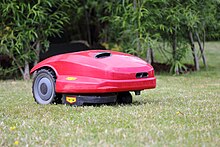
A typical lawn-mowing bot maintaining even and low grass.
Dethatching removes dead grass and decomposing materials that build up in a lawn
Lawn sweepers clean up debris from dethatching in addition to leaves, twigs, pine needles, etc.
Maintaining a rough lawn requires only occasional cutting with a suitable machine, or grazing by animals. Maintaining a smooth and closely cut lawn, be it for aesthetic or practical reasons or because social pressure from neighbors and local municipal ordina nces requires it,[38] necessitates more organized and regular treatments. Usually once a week is adequate for maintaining a lawn in most climates. However, in the hot and rainy seasons of regions contained in hardiness zones greater than 8, lawns may need to be maintained up to two times a week.
Social impacts
The prevalence of the lawns in films such as Pleasantville and Edward Scissorhands alludes to the importance of the lawn as a social mechanism that gives great importance to visual representation of the American suburb as well as its practised culture. It is implied that a neighbor, whose lawn is not in pristine condition, is morally corrupt, emphasizing the role a well-kept lawn plays in neighborly and community relationships. In both of these films, green space surrounding a house in the suburbs becomes an indicator of moral integrity as well as of social and gender norms as lawn care has long been associated with men. These lawns also reinforce class and socie tal norms by subtly excluding minorities who may not have been able to afford a house in the suburbs with a lawn that was the symbolic representation of safety and stability.[39] The lawn as a reflection of someone's character and the neighborhood at large is not restricted to films, the same theme is evident in The Great Gatsby, a book written by American novelist F. Scott Fitzgerald. Character Nick Carraway rents the house next to Gatsby's and fails to maintain his lawn according to West Egg standards. The rift between the two lawns troubles Gatsby to the point that he dispatches his gardener to mow Nick's grass and thereby create uniformity.[40]
Most lawn care equipment over the decades has been advertised to men, and companies have long associated good lawn care with good citizenship in their marketing campaigns. As well, the appearance of a healthy lawn was meant to imply the health of the man taking care of it; controlled weeds and strict boundaries became a practical a pplication of the desire to control nature, as well as an expression of control over their personal lives once working full-time became central to suburban success. Women were encultured over time to view the lawn as part of the household, as an essential furnishing, and to encourage their husbands to maintain a lawn for the family and community reputation.[11]
During World War II, women became the focus of lawn-care companies in the absence of their husbands and sons. The lawn was promoted as a necessary means by which women could help support their male family members and American patriotism as a whole. The image of the lawn changed from focusing on technology and manhood to emphasizing aesthetic pleasure and the health benefits derived from its maintenance; it was assumed that women would not respond positively to images of efficiency and power. The language of these marketing campaigns still intended to imbue the female population with notions of family, motherhood, and t he duties of a wife; it has been argued that this was done so that it would be easier for men returning from war to resume the roles their wives had taken over in their absence. This was especially apparent in the 1950s and 1960s, when lawn-care rhetoric emphasized the lawn as a husband's responsibility and as a pleasurable hobby when he retired.[11]
The lawn aesthetic in Europe and Australia seems to exhibit the same cultural tendencies as a representation of order, power over nature, patriotism, and suburban family life while still adhering to other gender constructs present throughout the world's suburbs. However, there are differences in the particulars of lawn maintenance and appearance, such as the length of the grass, species (and therefore its color), and mowing.[26][41]
Environmental concerns
Greater amounts of chemical fertilizer and pesticides are used per acre of lawn than on an equivalent acre of cultivated farmland,[42] and the continued use of the se products has been associated with environmental pollution, disturbance in the lawn ecosystem, and increased health risks to the local human population.[43]
Other concerns, criticisms, and ordinances regarding lawns come from the environmental consequences:
Lawns can reduce biodiversity, especially when the lawn covers a large area. Lawns - particularly in the United States - may be composed of introduced species not native to an area, which can produce a habitat that supports a reduced number of species.[44]
Lawn maintenance may use inorganic fertilizers, synthetic pesticides, herbicides, and fungicides, which can harm the environment. The United States Environmental Protection Agency has estimated nearly 70,000,000 pounds (32,000,000kg) of active pesticide ingredients are used on suburban lawns each year in the United States.[45] It has also been estimated that more herbicides are applied per acre of lawn than are used by most farmers to grow crops.[21]For e xample, Sweden, Denmark, Norway, Kuwait, and Belize have placed restrictions on the use of the herbicide 2,4-D.
It has been estimated that nearly 17 million gallons of gasoline are spilled each summer while re-fueling garden and lawn-care equipment in the United States; approximately 50% more than that spilled during the Exxon Valdez incident.[21]
The use of pesticides and fertilizers, requiring fossil fuels for manufacturing, distribution, and application, have been shown to contribute to global warming, whereas sustainable organic techniques have been shown to help reduce global warming.[46]
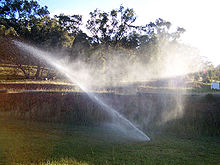
A lawn sprinkler
Water conservation
Maintaining a green lawn sometimes requires large amounts of water. This is not normally a problem in the temperate British Isles, where the concept of the lawn originated, as natural rainfall is usually sufficient to maintain a lawn's health, although in times of drought hosepipe bans may be implemented by the water suppliers.[47] The exportation of the lawn ideal to more arid regions of the world, however, such as the U.S. Southwest and Australia, has crimped already scarce water resources in such areas, requiring larger, more environmentally invasive water supply systems. Grass typically goes dormant during cold, winter months, and turns brown during hot, dry summer months, thereby reducing its demand for water. Many property owners consider this "dead" appearance unacceptable, and therefore increase watering during the summer months. Grass can also recover quite well from a drought.
In t he United States, 50 to 70% of residential water is used for landscaping, most of it to water lawns.[45] A 2005 NASA study "conservatively" estimated there was 128,000 square kilometres (49,000sqmi; 32,000,000 acres) of irrigated lawn in the US, three times the area of irrigated corn.[48]
"
That means about 200 gallons of fresh, usually drinking-quality water per person per day would be required to keep up our nation's lawn surface area.
"
It is possible that lawn maintenance could come at the expense of precious resources, especially when faced with extreme weather conditions. This situation is described in Water in Australia by David Ingle Smith, who observed in 1995 data that under extreme conditions during summer drought periods, up to 90% of the water used in Canberra, Australia was applied to lawns.[49]
Chemicals
An increased concern from the general public over pesticide and fertilizer use and their associated health risks, combined with the implementation of the legislation, such as the US Food Quality Protection Act, has resulted in the reduced presence of synthetic chemicals, namely pesticides, in urban landscapes such as lawns in the late 20th century.[50] Many of these concerns over the safety and environmental impact of some of the synthetic fertilizers and pesticides has led to their ban by the United States Environmental Protection Agency and many local governments.[43] The use of pesticides and other chemicals to care for lawns has also led to the death of nearly 7 million birds eac h year, a topic that was central to Silent Spring by the conservationist Rachel Carson.[21]
Decreasing environmental impact
In the United States, lawn heights are generally maintained by gasoline-powered lawnmowers, which contribute to urban smog during the summer months. The EPA found, in some urban areas, up to 5% of smog was due to small gasoline engines made before 1997, such as are typically used on lawnmowers. Since 1997, the EPA has mandated emissions controls on newer engines in an effort to reduce smog.[51]
A 2010 study seemed to show lawn care inputs were balanced by the carbon sequestration benefits of lawns, and they may not be contributors to anthropogenic global warming.[52][53]
However, lawns with high maintenance (mowing, irrigation, and leaf blowing) and high fertilization rates have a net emission of carbon dioxide and nitrous oxide that have large global warming potential.[54]
With the use of ecological techniques including organ ic lawn management, the impact of lawns can be reduced. Such methods include the use of native grasses, sedges, and low herbs; higher mowing techniques; low volume irrigation, 'grasscycling' grass clippings in place; an integrated pest management program; exclusive organic fertilizer and compost use; and including a variety of trees, shrubs, perennials, and other plants surrounding the lawn. A positive benefit of a healthy lawn is it filters contaminants and prevents runoff and erosion of bare soil.
Replacing turf grass with low-maintenance groundcovers or employing a variety of low-maintenance perennials, trees and shrubs[44] can be a good alternative to traditional lawn spaces, especially in hard-to-grow or hard-to-mow areas, as it ?an reduce maintenance requirements, associated pollution and offers higher aesthetic and wildlife value.[55]
See also
Lawns
Grasses
Grasslands
Lawn topics
Lawn sweeper
Lawn aerator
Organic lawn management
Gardening
Gardening
Organic gardening
Organic horticulture
Sustainable gardening
Sustainable landscaping
List of organic gardening and farming topics with links
^ a b Robbins, Paul. Lawn People: How Grasses, Weeds, and Chemicals Make Us Who We Are. Philadelphia: Temple University Press, 2007.
^ "Online Etymology Dictionary". Etymonline.com. 10 June 1927. Retrieved 11 June 2013.
^ "laund". Oxford English Dictionary. Retrieved 27 March 2013.
^ "Etymology for "lawn"". Etymonline. Retrieved 5 June 2015.
^ Hostetler, Mark E. (2012-02-07). The Green Leap: A Primer for Conserving Biodiversity in Subdivision Development. University of California Press. ISBN9780520271104. < br>^ "Lancelot Brown". Encyclopdia Britannica, Encyclopdia Britannica Online. Encyclopdia Britannica Inc. 2007. Retrieved 12 March 2012.
^ Walpole, Horace (1905) [1780]. On Modern Gardening. Canton, Pa.: Kirgate Press. at Internet Archive
^ "Lancelot 'Capability' Brown (1716-1783)". Kew History & Heritage. Kew Gardens. Archived from the original on 8 October 2012. Retrieved 16 March 2012.
^ Peter Willis, "Capability Brown in Northumberland" Garden History 9.2 (Autumn, 1981, pp. 157-183)
^ a b c d e f g h i j k l Jenkins, Virginia S. The Lawn: A History of an American Obsession. Smithsonian Institution, 1994.
^ "Gardening - Design - Georgian and Regency". BBC. Retrieved 24 May 2009.
^ US RE 8560, Passmore, Everett G., "Improvement in Lawn-Mowers", published 23 February 1869, issued 28 January 1879; see pg 1, col 2. For a copy, see Google Patents copy. This source indicates the patent number as "6,080". According to "British patent numbers 161 7 - 1852 (old series)", the patent number was assigned sometime after 1852 and took the form of "6080/1830".
^ "People at the cutting edge: lawnmower designers". Parks & Gardens UK (University of York/Association of Gardens Trusts). Retrieved 24 May 2009.
^ "The History of the LawnMower". Thelawnmower.info. Retrieved 23 April 2011.
^ Australian Broadcasting Corporation's Radio National Ockham's Razor, first broadcast 6 June 2010.
^ "The suburban aspiration in England since 1919". Contemporary British History. 14: 151-174. doi:10.1080/13619460008581576.
^ "Henrietta Barnett and the Beginnings of the Suburb". Archived from the original on 6 December 2013.
^ "Suburban Ideals on England's Interwar Council Estates". Retrieved 17 December 2012.
^ a b c d e f g h i Steinberg, T. (2006) . American Green, The Obsessive Quest for the Perfect Lawn. W.W. Norton & Co. ISBN 0-393-06084-5.
^ Influence of catalogs: See America's Romance with the English Garden by Thomas J. Mickey, 2013. Cited at [1]
^ Teysott, Georges (1 June 1999). The American Lawn. Princeton Architectural Press. p.18. ISBN1568981600.
^ a b Trudgill, Stephan; Jeffery, Angus; Parker, John (2010). "Climate Change and the Resilience of the Domestic Lawn". Applied Geography. 30 (1): 177-190. doi:10.1016/j.apgeog.2009.08.002.
^ Wood, Richard V. (2002). "Richardson, Mervyn Victor (1894 - 1972)". Australian Dictionary of Biography. Canberra: Australian National University. Retrieved 2007-08-25.
^ a b Hogan, Trevor. " 'Nature Strip': Australian Suburbia and the Enculturation of Nature." Thesis Eleven 74:1 (2003): 54-75.
^ Australian Bureau of Statistics, 1998
^ "Making Silage from Lawn Clippings". Grit. Retrieved 2016-01-05.
^ Logsdon, Gene (2004). All Fles h Is Grass. Ohio: Swallow Press. pp.Chapter 20. ISBN978-0-8040-1068-9.
^ Huxley, A., ed. (1992). Lawns. In New RHS Dictionary of Gardening 3: 26-33. Macmillan. ISBN 0-333-47494-5
^ a b c d e f Bornstein, Carol, Fross, David, and O'Brien, Bart; 'California Native Plants for the Garden;' Cachuma Press, Los Olivos, CA; 2005; ISBN 0-9628505-8-6, 0-9628505-9-4. pp. 74-5.
^ Lunn, Matthew (7 September 2004). "Fact Sheet: Lawn Alternatives". Gardening Australia. Retrieved 16 September 2009.
^ a b Christie, Mike (13 March 2007). "Private Property Pesticide By-laws In Canada" (PDF). The Coalition for a Healthy Ottawa.
^ "Why We Support a Province-wide Ban on Cosmetic Pesticides" (PDF).
^ Mittelstaedt, Martin (22 April 2008). "Ontario to prohibit cosmetic-use pesticides". Globe and Mail. Archived from the original on 28 August 2008.
^ Benzie, Robert (22 April 2008). "Pesticide ban set to grow". Toronto Star.
^ UC Statewide Integrated Pest Management Program. access date: 25 May 2010
^ "High Weed/Grass Complaint Process". City of Akron, Ohio.
^ Dickinson, Greg (2006). "The Pleasantville Effect: Nostalgia and the Visual Framing of (White) Suburbia". Western Journal of Communication. 70 (3): 212-233. doi:10.1080/10570310600843504.
^ Fitzgerald, F. Scott. The Great Gatsby. New York: Charles Scribner's Sons, 1925.
^ Sedgman, K (1997). "Cutting Grass: In Search of the Australian Male". Australian and New Zealand Journal of Family Therapy. 18 (3): 143-147. doi:10.1002/j.1467-8438.1997.tb00284.x.
^ Coates, Peter (2004). "Emerging from the Wilderness: (or, From Redwoods to Bananas): Recent Environmental History in the United States and the Rest of the Americas". Environment and History. 10: 407-38. doi:10.3197/0967340042772676.
^ a b Alumai, Alfred. "Urban Lawn Management: Addressing the Entomological, Agronomic, Economic, and Social Drivers." PhD., Ohio State University, 2008. ^ a b Rebecca Pineo. Susan Barton. Turf Grass Madness: Reasons to Reduce the Lawn in Your Landscape
^ a b "Cut Your Lawn - In Half!". National Wildlife Federation.
^ Sayre, Laura. "Organic farming combats global warming--big time". Rodale Institute.
^ "Hosepipe ban". Retrieved 21 January 2015.
^ Milesi, Cristina; S.W. Running; C.D. Elvidge; J.B. Dietz; B.T. Tuttle; R.R. Nemani (8 November 2005). "Mapping and modeling the biogeochemical cycling of turf grasses in the United States". Environmental Management. 3: 426-438. doi:10.1007/s00267-004-0316-2. Retrieved 5 November 2010.
^ David Ingle Smith (1998). Water in Australia: Resources and Management. Oxford University Press, Melbourne
^ Alumai, Alfred; Salminen, Seppo O.; Richmond, Douglas S; Cardina, John; Grewal, Parwinder S. (2009). "Comparative Evaluation of Aesthetic, Biological, and Economic Effectiveness of Different Lawn Management Programs". Urban Ecosyst. 12: 127-144. doi:10.1007/s 11252-008-0073-8.
^ "Answers to Commonly Asked Questions from Dealers and Distributors" (PDF). U.S. EPA. August 1998.
^ "Lawns may contribute to global warming" by Judy Lowe, Christian Science Monitor, 22 January 2010.
^ "Retrieved 17 May 2010". sciencedaily.com.
^ Townsend-Small, Amy; Czimczik, Claudia (March 2010). "Correction to "Carbon sequestration and greenhouse gas emissions in urban turf"". Geophysical Research Letters. 37 (http://www.agu.org/journals/gl/gl1006/2010GL042735/2010GL042735.pdf). Bibcode:2010GeoRL..37.6707T. doi:10.1029/2010GL042735. Retrieved 15 March 2012.
^ Rebecca Pineo, Botanic Gardens Intern Susan Barton, Extension Specialist. Groundcover Alternatives to Turf Grass
Further reading
Bormann, F. Herbert, et al. (1993) Redesigning the American Lawn.
Huxley, A., ed. (1992). New RHS Dictionary of Gardening. Lawns: Ch. 3: pp.26-33. Macmillan. ISBN 0-333-47494-5.
Jenkins, V. S. (1994). The Lawn: A Hist ory of an American Obsession. Smithsonian Books. ISBN 1-56098-406-6.
Steinberg, T. (2006). American Green, The Obsessive Quest for the Perfect Lawn. W.W. Norton & Co. ISBN 0-393-06084-5.
Wasowski, Sally and Andy (2004). Requiem for a Lawnmower.
External links
Media related to Lawns at Wikimedia Commons
Wikisource has the text of the 1920 Encyclopedia Americana article Lawns.
"Planting and care of Lawns" from the UNT Govt. Documents Dept.
Integrated Pest Management Program: website & search-engine
Lawn Care University at Michigan State University
"EPA Management of Polluted Runoff: Nonpoint Source Pollution" (includes mismanagement of lawns problems.)
v
t
e
Lawn and garden ornaments
Lawn
Bird bath
Bathtub Madonna
Concrete Aboriginal
Concrete goose
Garden gnome
Lawn jockey
Plastic flamingo
Suncatcher
Whirligig
Yard globe
Garden
Puteal
Suikinkutsu
Sundial
Wind chime
Wishing well
Authority control
NDL: 00570873
Retrieved from "https://en.wikipedia.org/w/index.php?title=Lawn&oldid=783034188"
Finding an Energy-Saving Space Heater in 2017: Keep Warm on a Budget
Winter is on approach, and it's getting colder. I live in a part of the world where heaters are a necessity, and it can get pretty expensive burning natural gas all winter. Sometimes central air heating isn't practical. A small, energy-efficient space heater can be the perfect thing.
That said, not all space heaters are the same. Some make use of ceramics and others make use of other technology. They're all different shapes and sizes, and some of them are a huge drain on your electrical bill each month. Some are even fire hazards!
Because it can be tough to narrow down a heater that combines good energy efficiency, low price, safe operation and small size, I'm writing an article to showcase a few good ones. We'll look at six (plus a bonus one) of the best energy saving space heaters and give a run-down of their specs and how well they operate. I'll also briefly touch on a couple of the popular t echnologies these days, so you'll understand what you're looking at! Let's begin.
Different Types of Space Heaters
There are many different types of energy efficient space heaters, and they're all subtly different. Here's a brief description of a few of the popular styles:
Convection Style
These are built to gradually increase the air temperature of the whole room, by directing warm air upwards. They work slowly, but they can fill a whole room with warmth. Some examples of this include baseboard heaters and oil and water radiators1 (despite the name, a radiator heater uses convection, not radiant heat).
Radiant Style
Radiant style heaters2 work more quickly, but they direct their temperature in a single direction. They're useful for heating up a single person or single area of a room. Most ceramic and infrared style heaters are radiant style. They're quicker, but typically use a bit more electricity.
There are also some hybrid style s pace heaters that are very energy efficient. They make use of a combination of the two styles I just covered.
Lasko Designer Oscillating, Energy-Saving Space Heater
If you're after a relatively inexpensive space heater that's energy efficient and looks great, this product by Lasko might be right up your alley. It has a wide range of features and it's really user-friendly.
With up to 1500 watts of heat, this is a powerful heater in a small package. It oscillates widely on its base and has a bunch of different temperature presets on the top, as well as various fan outputs that let you control how much heat is produced and how widely it's distributed in the room. That makes it wonderful for just a single person, but it's also useful for a larger space too.
The housing is unique among space heaters in that it looks sort of like an urn or decorative vase, definitely nothing like the sterile gray that space heaters usually come in.
The heater unit is ceramic, so this should be considered a radiant heater. With that said, it's actually pretty good at warming up a pretty big room in short order. Because it relies on ceramic elements, it warms very quickly, but it won't maintain that warmth as long. It's good for heating up a well-insulated space quickly, but it becomes less efficient if it has to run constantly.
It is sturdy, very quiet, attractive, and doesn't tip over easily. Beyond that, it's a pretty efficient electric space heater that will last.
Dyson Hot + Cool: A Versatile and Powerful Heater / Fan Combination
You may have seen the advertisements lately extolling the virtues of the new Dyson vacuum and fan products. I've checked them out and I have to say they're living up to the hype.
They may be on the expensive side, but all Dyson products are very intelligently designed and built to be not only powerful but beautiful too.
This particular space heater and fan is efficient, energy saving, and versatile. You can use it as a heater in the cold months, and then switch it to a fan to blow cool air during the summer. No more storing it in the basement for half the year!
Their "air multiplier" technology means that the air is drawn in from around the device rather than pushed through. That results in a "buffet-less" airflow that's far more relaxing than a conventional fan.
That same air multiplier means that heat is pushed efficiently through the room, so you don't have to sit directly in front of it to gain the benefits, and it's good for heating up a decent-sized space.
It tilts and oscillates, and it's capable of projecting a huge volume of air, so it can really warm up a big space quickly. Surprisingly enough, it doesn't draw a huge amount of juice either, so your electrici ty bill isn't going to expand too much. It even avoids that typical space heater "burning smell" generated by dust on the elements!
DeLonghi Safeheat Oil Radiator: Inexpensive and Powerful
I usually recommend an oil radiator for anyone who needs consistent heat in a small space, because they're among the most energy efficient space heaters on the market today. This example by DeLonghi shows you just how much you can get for well under $100.
The advantage of oil radiators is that the oil inside retains heat really well. Once it's heated up, you can actually turn it off or lower the heat, and it will continue to provide convection warmth throughout the space for a long time afterward.
This particular radiator has fins that never need to be refilled or topped up with oil. The unit can be set to automatically turn on when the room drops below 44 degrees Fahrenheit, and it will also automatically shut off when the heat gets too high.
It's also virtually silent; the only thing you'll hear is the occasional "ticking" of metal expanding and contracting. I had one of these operating in my bedroom for years, and they're wonderful!
They do take a bit of time to warm up, and likewise if it gets too hot they take some time to cool as well, but it's an extremely safe and very energy-efficient space heat option that won't break the bank.
Dr Infrared Quartz Space Heater: Attractive and Potent
You might have seen infrared heaters like this one advertised on late night television. They're pretty popular and gaining fans every day. They're a bit larger in size than your conventional space heater, but they provide a huge amount of heat without drawing a ton of power.
They're big, but not hu ge, at around 13 x 11 x 16 inches in dimension. They're definitely what I'd consider portable, because you can tote them around easily enough.
The technology incorporates typical element heating with infrared heat, which is where the 'quartz' in the name comes from (infrared heaters typically use a quartz tube of some kind). That means that it heats up extremely quickly and will start projecting almost the moment you switch it on.
These heaters make claims of heating up to 1000 square feet. In my experience, that's not realistic. However, they're pretty good at heating up spaces of up to 500 square feet quickly, and they have the capability to fill the room with warmth rather than just blasting it in a single direction.
Feature-wise, it has a 12-hour timer, a fairly quiet fan, front panel push-button controls that are simple to use, and a very pr ecise thermostat to regulate the temperature. It has a three-year warranty too.
It's a very energy-efficient infrared space heater that happens to look great too! Worth taking a look at for sure.
Delonghi Panel: A Low-Profile, Energy-Saving Space Heater With Great Reviews
If you're after a heater that's pretty low-profile and doesn't get in the way, or if you just want something that's powerful enough to heat a room without being the center of attention, you might be interested in this panel heater by Delonghi.
These heaters take advantage of 'micathermic technology', which allows heat elements to be arrayed in extremely thin panels. That means that this is the only space heater reviewed here that can be mounted on the wall safely.
I'd definitely classify it largely as a convection heater, meaning that it won't "spot heat" as well as some of the others I've listed, but it will quickly warm up a whole room and make everyone toasty.
Being this thin, it obviously doesn't have a fan, so it can't project the heat outward, but that means it's totally silent while it operates (apart from the odd metal "tick").
It has a high and a low setting (1500 and 750 watts, respectively), and it comes with an internal tip sensor that will shut it off it, even if it's not using the included wheeled base.
Simple controls, light weight, and the ability to mount it on the wall make it a strong candidate, and it's definitely one of the most energy-efficient space heaters for sale these days. Read the reviews and you'll see what I mean!
Bonus Review: A "Stealthy," Wall-Mounted, Energy-Saving Space Heater
OK, so I recently ran across another fantastic heater, and I've decided to add a bonus review, because this is an exciting product. The Cozy-Heater is a fantastic and well-designed heater that solves the problem of "it's effective, but ugly." These heaters look great!
They have the look of a modern art panel on your wall, and best of all they're not underfoot, so there's no risk of tipping over. Most visitors won't even realize they are heaters at all.
These heaters are similar to mica panel heaters in that they don't include a fan, instead relying on convection to gradually heat up a room. They're a little bit unorthodox in that they are available in both 400 and 600 watts, quite a bit less energy than a lot of other heaters on full blast. One 600-watt model is rated to heat a 100 square foot room on its own.
The advantage here is clear: they are extr emely energy efficient. You can run two Cozy-Heater wall panels at once, using less energy than a 1500 Watt heater on full blast.
As for safety, these heaters have no exposed elements, so they're child-safe and very durable. With no fan, they don't kick up dust, so they're hypoallergenic.
The idea here is to use consistent convection to maintain a uniform room temperature. They take a long time to heat up, but you'll notice a difference in your heating bill over time.
A few notes: if you do have a larger room to heat, you'll want to pick up several (perhaps a 600 and a 400). If you don't want to be constantly plugging and unplugging, you can pick up a programmable thermostat outlet for your heaters to click them on at a set time.
All in all the Cozy-Heater is on of the most energy-efficient space heaters that I've come across, and worth your time to investigate.
What's the Best Heating Technology?
Micathermic, infrared, radiant: there's a lo t of jargon in this field. It's not always easy to isolate the type of heater you want for your purposes.
To narrow it down, I'd encourage you not to worry so much about the jargon and focus more on the individual heaters themselves.
As yourself a few questions: is it a heater for just one person, or for many? If it's for one person, go for a "spot heater" like the Dyson or the Lasko. If it's for many people, opt for a convection heater like the radiator or the micathermic panel heater. If you prefer instant heat, remember that infrared converts 86% of electrical energy into instantaneous heat3 without the need for a fan.
Another good cue is to read customer reviews closely. Find out what the customers' experiences were, and if your needs match up with what they tell you. The companies will only lay out the good info, whereas customers give it to you straight.
If you have Best Electrician Service a ny questions regarding the technology involved, the terminology, or any of the products I've listed, please feel free to comment in the forum below! Thanks for reading!
TORONTO As climate change makes longer, drier summers a reality in many parts of the world, a new trend in landscaping is taking root in Canada.
In Toronto, where precipitation levels were 52 percent below the seasonal average over the past six months, according to government data, residents are trading in their manicured lawns for environmentally friendly organic landscapes.
"Irrigation is a huge issue as water is such a valuable resource," said Claire Suo-Cockerton of landscaping company Aesthetic Earthworks. "We are trying to plant material that is more appropriate today in our climate."
Organic landscapers use drought resistant plants and shrubs native to the region, which encourage the development micro-organisms in the soil. This attracts birds and insects to act as natural pest and disease control.
A well-managed organic landscape is self-sustaining, whereas a traditional yard needs to be watered at least onc e per week, Suo-Cockerton said.
"It's a drastic lifestyle change for those who incorporate it in their homes," she added.
But the change may be a bit too drastic for average homeowner.
Kevin MacDonald, operations manager of Humber Nurseries near Toronto, said he hasn't seen an increase in the sale of native plants and shrubs. He said the downside to native plants is they are more susceptible to native insects.
"By planting a cultivated variety, that is non-native, you may not end up with diseases and insect problems, simply because the diseases and insects that would traditionally attack that plant are not found in the new location," he said.
Still, the main reason why traditional gardens remain popular may be purely aesthetic.
"In most cases homeowners will have a preference for what looks best," MacDonald said.
While Sprinkler System Arlington the bare shrubs and woodchips of an organic landscape don't quite have the curb appeal of an ornamental garden, commercial and residential buildings looking to go green are picking up on the trend.
The CGBG uses the leadership in energy and environmental design (LEED) standard developed in the United States to measure the "green factor" of a building. Avoiding pesticides, lawnmowers and leafblowers all reduce a building's carbon footprint, contributing to a higher LEED score.
"Native, organic plants is what we're all about," said Ferrato. "W e really discourage the Sprinkler System Arlington use of manicured lawns and pesticides."
While organic landscaping is only now gaining popularity in the private sector, it has long been used by city parks departments.
"We've been moving away from traditional lawns for many years now," said Patricia Landry a liaison officer at the Toronto parks department. "We are using plants able to withstand drought, pollution and the changing climate."
Organic landscaping makes economic sense for urban municipalities, Landry said. Less money is spent on labor and irrigation. And reintroducing native plants provides habitat for birds and small animals.
While efforts to convert Toronto's ornamental flowerbeds to organic gardens were met with public opposition, some of the cultivated annuals were swapped with native plants.
"It's about trying to keep a balance," said Landry. "Finding different ways to keep those areas a little more environmentally friendly."
A 2-year-old girl, named Ishneed Kaur, was bitten by a rattlesnake, June 9, 2015, while playing in her backyard in Pittsburg, California. She had to https://dengarden.com/gardening/ be airlifted to Children's Hospital in Oakland for immediate treatment.
That same week, a 4-year-old boy was bitten after stepping on a baby rattlesnake coiled on a bike trail in Folsom, California. When his ankle started to swell and turn purple as a result, the child's mother, Jacklyn Caramazza, jumped into action and sucked the venom from his wound; a dangerous move, which may have saved the boy's life, but most experts don't recommend.
Did You Know?Before the distance of a mile was standardized, almost every country had their own measurement of the mile. Thus, the Scandinavian mile, which incidentally is still in use today, measured 10,000 meters!
Though we learn the metric conversion system in school, we tend to forget it as we grow older, for the simple reason that we never need to use it. However, at some point of time, it becomes important to know some basic conversions, and miles to feet is one of them.
A mile is a common unit of measurement for distance, and is used whereve r distance has to be measured. Because some countries still follow the Imperial System of measurement, we, at https://www.youtube.com/watch?v=UBmN2PTUB7w times, need to convert miles in to other units of measurement. The most popular, of course, is converting to kilometers, when you want to convert something like MPH (miles per hour) to KMPH (kilometers per hour). Other popular units of conversion include feet, yards, and inches.
Mile Converter
Given below are 3 converters that will convert the quintessential mile to feet, inches, and yards. You can enter the number of miles in the first box, and the result will display in the second box.
The History of the Mile
The Mille Passuum or the Roman Mile
Long, long ago, when the Romans ruled over British lands, they used a measurement scale that was known as the 'mille passuum', which meant nothing but a thousand paces. This was measured by soldie rs marching a thousand paces, or 5000 Roman feet. By conventional standards, this measures out to be about 1,479 meters, or about 1,617 yards, and is today known as the Roman Mile. This unit of measurement was used by the entire Roman Empire, who even changed the local systems of measurement to adhere to this.
The British Mile
After the fall of the Roman Empire, the British came up with their own system of measurement. In their system, they used a 'furlong', which was the distance a horse could travel pulling a plow before stopping for rest, to measure distances. 1 furlong was equal to about 660 feet, making the mile 8 furlongs.
The International Mile
These and other similar methods http://www.tyco-fire.com/index.php?P=detailprod&S=1710 led to a varied measurement of the mile. This was solved, to some extent, with the adoption of the international yard and pound measurements, which were agreed upon by 6 countries, which included the United States, United Kingdom, Canada, Australia, New Zealand, and South Africa. In this agreement, 1 yard was exactly 0.9144 meters. With this agreed unit of measurement, the mile came to be 1,609.344 meters, and was known as the 'International Mile'. There were exactly 1760 yards in a mile using this system. While the US follows the International Mile, they also use the US Survey Mile or the Statute Mile, which measures 1,609.347219 meters, or about 3.2 mm longer than the International Mile.
The Statute Mile
The statute mile, so termed as it was defined by an English Act of Parliament, is another measurement of the mile. The statute, which was during the time of Queen Elizabeth I, states: "A Mile shall contain eight Furlongs, every Furlong forty Poles, and every Pole shall contain sixteen Foot and an ha lf." (35 Eliz. Cap. 6.). This also works out https://www.youtube.com/watch?v=UBmN2PTUB7w to be about 1760 yards, 5280 feet, or 1609 meters.
The Metric and Nautical Mile
Besides these, there is the Metric Mile, which is used in sporting events where distance is to be measured, like track and field events. 1 Metric Mile is equal to 1500 meters. The Nautical Mile is a measurement used in sea and air travel, and is defined as 'one minute of arc measured along any meridian'. 1 International Nautical Mile is measured at exactly 1,852 meters or 6,076.12 feet.
At various times in history, there have been various measurements of the mile. Today, most countries have moved from the Imperial System of measurement to the International System of Units of measurement. However, the mile is still an important unit of measurement, and at times, it is important to know how many feet equal a mile.










 Media related to Lawns at Wikimedia Commons


